


In my experience, not all publicity is good publicity. But it sure does seem like the Department of War tweeting incendiary things about you as part of a campaign against AI safety is good publicity.


Was effective altruism on the cover of The Economist before? As the century’s biggest idea?! It was not!
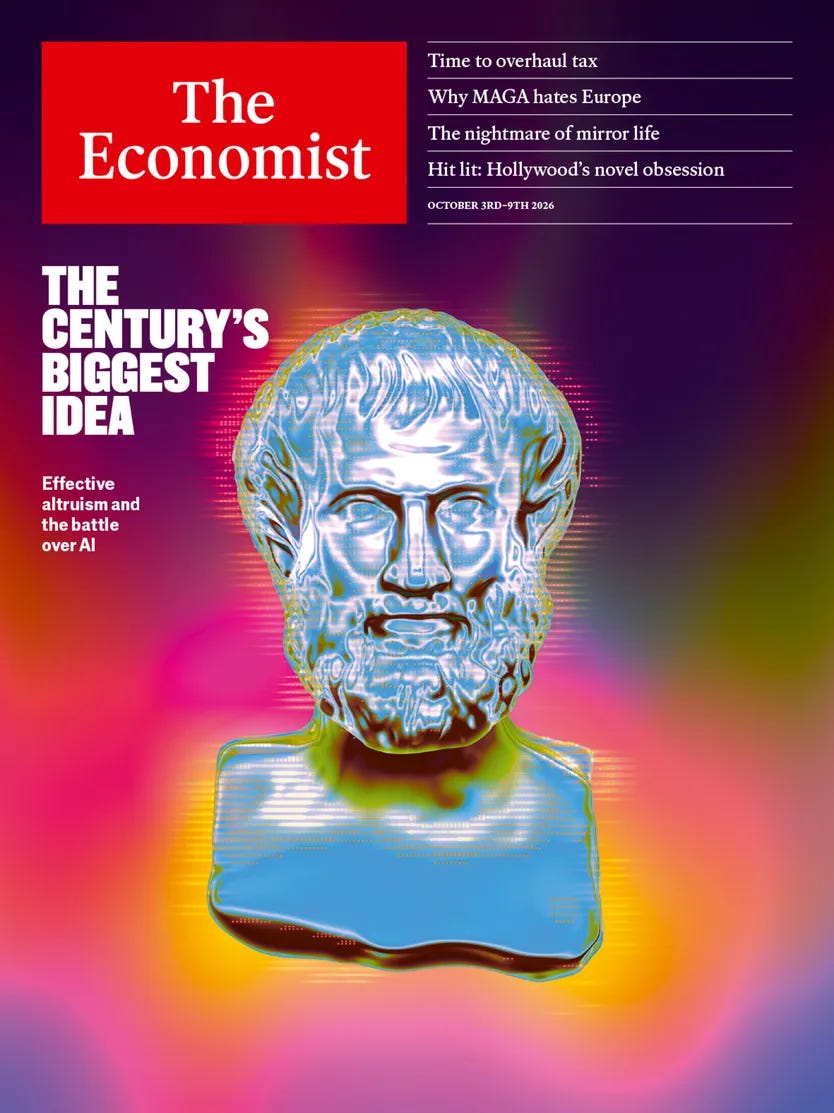
“EA is many things,” I told an interviewer recently, before rambling about some of them. Afterwards, chastened, asking myself, “more than four years at the Centre for Effective Altruism and you don’t have a better answer ready to roll?!”1
Obviously, should’ve led with Moneyball.
“Moneyball for morality”
– Former NYT tech columnist Kevin Roose, recently
Moneyball, to me, was proof that spreadsheets can uncover important truths about the world in the places you’d least expect, and most care about. (Proof, as well, that taking analytical ideas seriously and putting them into practice would get you yelled at.) Follow that thought, and there’s a decent chance you land in a franchise front office, finance, or effective altruism.
“Analytics are just some crap some people who were really smart made up just to get in the game because they had no talent”
– Former NBA MVP Charles Barkley, as the 3-point revolution unfolded around him
I spent the first decade of my career making sure I had enough time to watch all the sport and read all the analytics blogs. Time wasted? It was not! I learned invaluable life lessons like three is greater than two and being right is not enough. Maybe there’s a world in which being a political adviser to a healthcare expert in the House of Lords during a pandemic is the perfect place to put this stuff into practice. Alas, we live in a world where the Science and Technology Committee spends countless hours arguing about whether probabilistic prediction models are admissible in government decision making while the curve goes up and up. (“So you’re saying the hospitals might not be full in two weeks? Let’s wait and see.”)
I found the fact that the area under the curve was measured in the deaths of strangers more emotionally upsetting than I would have expected. Disillusioned by all the levers I pulled not doing anything, I did some quiet quitting and set about trying to find some levers that would. I read over a hundred books, about sport, naturally, about life, and about work, what it is and why we do it. Humblebrag, fine, but the denominator matters. Out of all of them, three stood out.
Peter Singer’s The Life You Can Save, Will MacAskill’s Doing Good Better and Toby Ord’s The Precipice are books about how helping others is one of the places spreadsheets can help uncover important truths.2 All the analytics had been training me for this moment, so exposure to EA ideas made it suddenly seem obvious that I would be able to do an awful lot of good with my time and money. If I put my mind to it instead of fantasy football.
What is effective altruism, according to me?
EA is asking the question: how can we do the most good with our time and money?
EA is the best set of ideas anyone’s found to answer this question.
EA is putting these ideas into practice.
These ideas
Everyone’s worthy of compassion. All joy and suffering counts. There are countless ways to make the world a better place.
Everything’s a tradeoff. Our time and money are finite. We can’t solve every problem. We have to choose.
More good is better than less good. Ten times as good is much better than twice as good.
Curiosity beats certainty. We don’t have all the answers. We need to take weird ideas seriously, and assess them on their merits.
These ideas have been core to EA since it began, seem unlikely to be proven wrong any time soon, and are routinely undervalued. On their face, they each seem agreeable. Unoriginal, even. Compassion? Witness Rafa’s shrine at Roland-Garros. Tradeoffs? Football is a short blanket. More good? MVPs are many times more valuable than the merely good. Uncertainty? 64% favourites lose 36% of the time.
Taken together, and taken seriously, these ideas can lead to unintuitive and uncomfortable places. It can feel destabilising, even “dangerous”, to consider that compassion compels us to factor in the experience of those far away and unfamiliar, of strangers and animals and so on. That tradeoffs require us to say no to good things, let some fires burn and accept the damage. That choosing more good means saving ten lives over two. That uncertainty means we’re never done asking: how are we wrong, and how can we do better?
In practice
How can we choose between so many problems to solve, and between so many ways to solve them? Choosing means comparing. Choosing more good over less means analytics.
Your salary cap is so many million. How should you spend it? Which players make how much difference, and how much is that worth? Which players will make how much difference, and how much is that worth?
Your donations might be thousands or millions or billions. Your career might be 80,000 hours. How should you spend them? Which interventions make how much difference, and how much is that worth? Which interventions will make how much difference, and how much is that worth?
You need evidence. You need reason. You need humility. You need expected value, cost-effectiveness, counterfactuals, to be calibrated, to account for your biases, to act under uncertainty, to change your mind. You need to prioritise. You need probabilistic prediction models. And you need to restrict vibes to their rightful place.
If you’re all vibes all the time, you lose. You find yourself squandering tens of millions on players who used to be good, like Manchester United, or were never good, like the Sacramento Kings, or $98,329 on a Steinway & Sons grand piano for the Air Force chief of staff’s home and $6.9 million worth of lobster tail, like the Department of War.
Analytics is always changing, because the evidence evolves, new ideas emerge, and our models improve. It’s not a theory of everything so much as a practice.
“We talkin’ about practice, not a game, not a game”
– Former NBA MVP Allen Iverson, who put it perfectly without meaning to
Dead serious
EA started with asking which charities make the biggest difference, and using cost-effectiveness analysis to identify those with the highest ratio of good done to dollars spent. Financiers in New York and philosophers in Oxford independently arrived at the same answer: there’s strong evidence that a few select charities can save the life of a child in Africa for a few thousand dollars. Early EA efforts focused on increasing the amount of money people in rich countries donate to these top charities, who can save 10 to 100 times as many life-years as the average global health charity would with the same money. Hundreds of thousands of lives have been saved as a result, and the majority of EA-inspired funding still goes to the most cost-effective global health charities.
Some in EA then asked: what if there were solvable problems even larger or even less well funded, where we might be able to make an even greater difference? Many tens of billions of animals live and die in inhumane conditions on factory farms. There is strong evidence that these animals suffer in similar ways to us, and that inexpensive campaigns against factory farm companies can dramatically change their fate. If you believe the experience of an individual chicken or shrimp has any moral weight, then the world is a much better place with hundreds of millions of them freed from torturous cages and billions spared from torturous slaughter methods. Funding for EA-inspired charities working on animal welfare is growing rapidly.
Some in EA then asked: what if there were solvable problems even larger and barely funded at all, where we might be able to make an even greater difference? Some problems which affect almost no one today could affect everyone tomorrow. A decade ago, before Covid and before ChatGPT, that was the case for pandemics and artificial intelligence. Ahead of time, people in EA identified both as significant risks that could be globally catastrophic, and which were receiving almost no attention from governments, companies, or charities.
Pandemic prevention and AI safety became a focus for many in EA, who founded and funded many of the leading organisations in the field. Even after Covid and ChatGPT, EA continues to provide a disproportionate amount of the resources spent on reducing these risks, pending others picking up the mantle. With this came another shift in emphasis, from money to time. Compared to global health and animal welfare, far fewer shovel-ready projects already exist, so these fields are in dire need of people using their careers to work directly on developing impactful interventions and building organisations to implement them.
And of course, some in EA are now asking: what if there are aspects to these problems or entirely new problems we’re all missing, where we might be able to make an even greater difference?
Training data
📖 Moneyball (2003) and 📺 He Gets On Base (2011). The rest is history.
🎵 Barbra Streisand (2010). “Woooooo, wooo-ooh, woooooo, wooo-ooh / Wooo, wooo, wooo-ooh, woooooo, wooo-ooh.”3
📝 Most Important Century (2021). We are living in history.
Next play
My counterfactual fantasy

According to the lamestream media, Mo Salah was merely an Egyptian king. Over here in Fantasyland, where everyman can pick his own poison and make his own name, Mo is our MVP, the Most Valuable Prophet.
Same playlist, ever growing
It’s worth saying at this point that EA is, in fact, many things, and different people define it differently. I like Ajeya’s version, and Andy Masley’s, among others. It’s also worth saying there’s a decent chance we’re all barking up the wrong tree, in the specific sense that by my lights the most likely morality to emerge from atoms bumping into each other is “lol nothing matters”. For as long as things might matter, though, it seems worth acting as though they do.
You can request a free copy of The Life You Can Save, Doing Good Better, The Precipice, and other EA-inspired books here.
“...Yo, I'll fucking help you type out your resume with the finest fonts / And set up your business plan / And I'll say that you're proficient at Microsoft Excel / And that you have good planning skills.”